Dreaming of building your perfect home but dreading the potential nightmare of juggling architects, builders, and surprise costs? The traditional construction process can often feel like a game of telephone, with miscommunications between separate teams leading to frustrating delays and budget overruns. But what if there was a way to avoid the blame game and ensure everyone is on the same team from the very beginning? This is where design build firms offer a revolutionary, streamlined solution.
In this complete guide for homeowners, we’ll pull back the curtain on the design-build model. You will learn how combining design and construction under one roof creates a single point of accountability, saves you significant time and money, and gives you a clear, upfront understanding of your project’s total cost. Prepare to discover a less stressful path to building the home you’ve always wanted, with confidence that your final design is both beautiful and buildable.
Key Takeaways
- The design-build model combines design and construction under one contract, creating a single point of responsibility for your entire home project.
- Discover how this integrated approach can lead to significant cost savings, faster project completion, and fewer communication headaches for homeowners.
- Understanding the step-by-step process used by design build firms helps you stay in control and make informed decisions from concept to final walkthrough.
- Learn the critical questions to ask and potential drawbacks to watch for to ensure you select a trustworthy partner for your home renovation or build.
The Design-Build Model Explained: One Team, One Contract, One Vision
Imagine hiring a single, unified team to take your project from a simple idea to a fully realized space. That’s the essence of working with design build firms. This approach streamlines the home renovation or building process by combining design and construction services under one roof, managed through a single contract. It’s a modern return to the age-old concept of the “master builder,” where one entity is responsible for a project’s vision, quality, and execution from beginning to end.
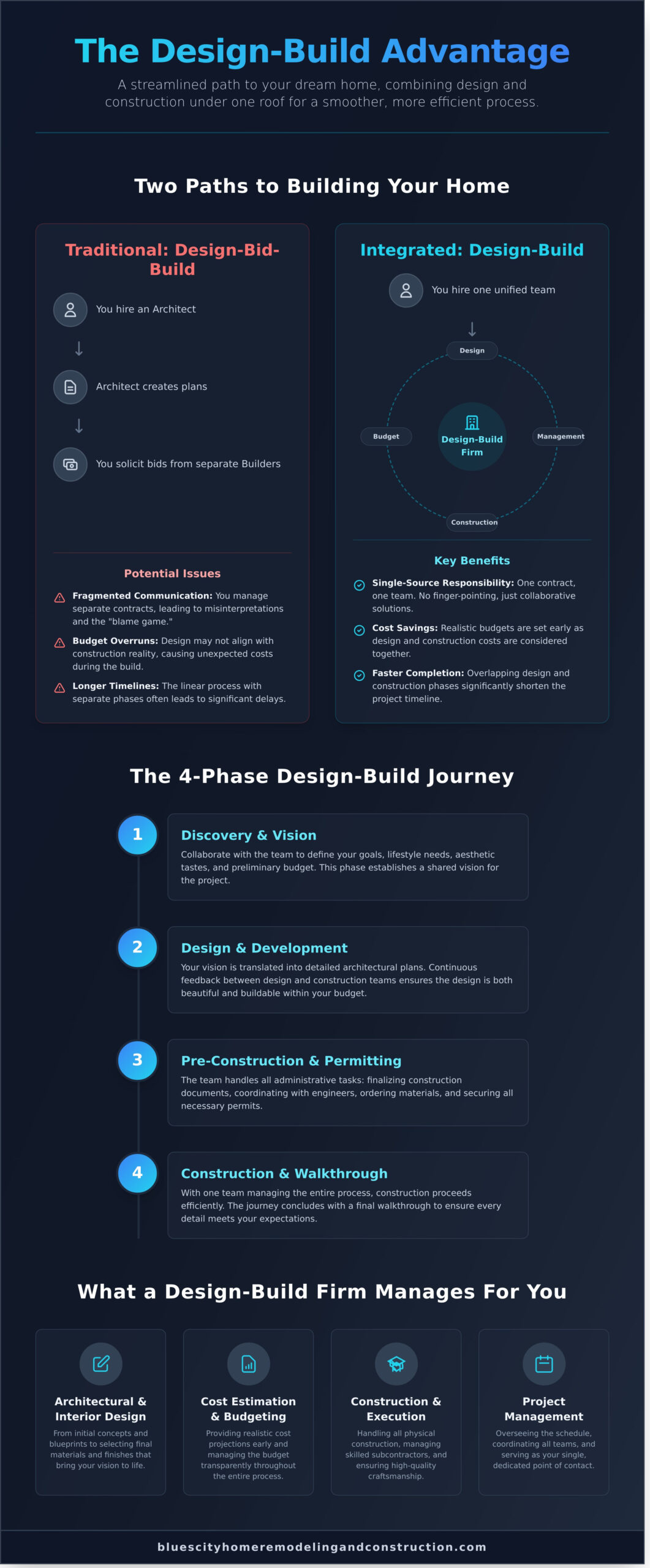
This stands in sharp contrast to the traditional “Design-Bid-Build” method, where a homeowner first hires an architect to create plans and then separately solicits bids from multiple builders to construct them. The integrated design-build model fosters collaboration from day one, ensuring that designers, project managers, and builders are all working together, aligned on the same goals, budget, and timeline.
What Roles Does a Design-Build Firm Cover?
A true design-build firm is a one-stop-shop, handling all critical phases of your project. Their integrated team typically provides a comprehensive suite of services, including:
- Architectural & Interior Design: Creating the initial concepts, detailed blueprints, and interior specifications that bring your vision to life.
- Project Management: Overseeing the entire project schedule, coordinating teams, and serving as your primary point of contact.
- Cost Estimation & Budget Management: Providing realistic cost projections during the design phase and managing the budget throughout construction.
- Construction & Execution: Handling all physical construction, managing skilled subcontractors, and sourcing high-quality materials.
The Key Difference: Single-Source Responsibility
The most significant advantage of the design-build process is single-source responsibility. Because one company is accountable for everything-from the blueprint’s accuracy to the quality of the final nail-there is no finger-pointing. If a problem arises, you have one team to call, and they are responsible for finding a solution. This accountability simplifies communication, streamlines decision-making, and ensures that the design intent is perfectly executed in the final build.
How is This Different from a General Contractor?
While people sometimes use the terms interchangeably, their roles are distinct. A general contractor (GC) is typically hired to manage the construction phase after the design plans are already complete. They execute a vision created by a separate architect. In contrast, a design-build firm creates the vision and executes it. This integration means design and construction planning happen simultaneously, allowing for real-time feedback on costs and feasibility, which ultimately leads to a more efficient and cohesive project.
The Design-Build Process for Homeowners: A Step-by-Step Journey
Embarking on a major home project, like a custom home build or a significant addition, can feel daunting. The design-build model simplifies this journey by integrating the entire process under one roof. Instead of juggling separate contracts with an architect and a builder, you have a single, cohesive team guiding you from the first sketch to the final walkthrough. Let’s explore the typical four-phase process from a homeowner’s perspective.
Phase 1: Selecting a Firm & Defining Your Vision
Your journey begins with finding the right partner. During initial consultations, you’ll discuss your high-level goals, lifestyle needs, aesthetic tastes, and preliminary budget. This is a collaborative discovery phase where the best design build firms will listen intently to understand not just what you want to build, but how you want to live in the space. The goal is to ensure a strong rapport and a shared vision before moving forward.
Phase 2: Architectural Design & Project Development
Here, your vision takes shape. The team translates your ideas into conceptual drawings and then into detailed architectural plans. A key difference in this model is the concurrent feedback loop; as you select materials, fixtures, and finishes, the team provides real-time cost and construction implications. This integration is one of the core advantages of the design-build approach, as it ensures the design evolves in lockstep with your budget. This phase concludes with a complete set of plans, a detailed scope of work, and a fixed-price construction agreement.
Phase 3: Pre-Construction & Permitting
With a finalized design and price, the project moves into the administrative stage. Your design-build team takes the lead on all the critical behind-the-scenes tasks. This includes creating final construction documents, coordinating with structural engineers, and submitting all necessary plans to your local municipality to secure building permits. Meanwhile, they begin ordering long-lead-time materials and scheduling trade partners to create a seamless project timeline.
Phase 4: Construction & Project Handover
This is when your vision becomes a reality. Your single point of contact-the project manager-oversees all daily operations on-site, from excavation to the final paint touch-ups. You are kept informed through regular, scheduled meetings and consistent communication. Because the team that designed the project is the same one building it, issues are resolved efficiently. The process culminates in a final walkthrough to ensure every detail meets your expectations before the keys are handed over.
Key Advantages of the Design-Build Approach for Your Home
Choosing a construction model is about more than just process; it’s about managing your project’s time, budget, and your own peace of mind. The design-build approach consolidates the entire project under a single contract, creating one unified team. This single-source responsibility is the engine behind its most significant benefits for homeowners.
Faster Project Delivery
In the traditional model, design must be fully completed before you can even begin the lengthy process of vetting and hiring a builder. With a design-build firm, design and construction phases overlap. For instance, site work and foundation pouring can begin while final interior details are still being designed. This parallel progress, combined with the elimination of a separate bidding period, can lead to significantly faster completion. Studies have shown that design-build projects can be delivered up to 33% faster than traditional projects.
Improved Cost Control and Budget Certainty
One of the biggest homeowner frustrations is receiving a beautiful architectural plan only to discover it’s 50% over budget. Design build firms prevent this sticker shock by integrating cost analysis from day one. The builder provides real-time cost feedback during the design phase, ensuring the plans align with your target budget. This early cost certainty minimizes the risk of expensive change orders later, which often arise from conflicts or omissions between separate design and construction plans.
Streamlined Communication and a Single Point of Contact
Imagine having a question about a material choice and a construction timeline. In a traditional setup, you might call the architect, who directs you to the builder, who might need to consult an engineer. In the design-build model, you have one dedicated point of contact. This individual is responsible for the entire project, from the first sketch to the final walkthrough. This streamlined communication eliminates the “blame game” and ensures that you always have a clear, single source for answers and updates, dramatically reducing project-related stress.
Enhanced Collaboration and Quality
When designers and builders work for the same company, they operate as a cohesive team, not as adversaries. This collaborative environment fosters innovation and practical problem-solving. The builder can inform the designer of a more efficient construction technique, while the designer ensures the building’s aesthetic integrity is never compromised. This unified approach is a core tenet of The Design-Build Process, where shared accountability ensures everyone is focused on the same goal: delivering a high-quality home that meets your vision and budget.
Potential Drawbacks and How to Ensure a Successful Project
The design-build model offers incredible efficiency, but like any approach, it’s wise to understand its potential pitfalls. Acknowledging these common concerns is the first step toward a successful partnership. A transparent firm will welcome these questions and have clear processes in place to address them, ensuring your peace of mind.
Concern: ‘Am I Getting a Fair Price Without Bids?’
In the traditional model, you can solicit bids from multiple builders for a completed design. With design-build, the construction pricing comes from within the firm. This can leave homeowners wondering if they are getting a truly competitive rate without that external bidding phase.
How to Mitigate:
- Request a Transparent Budget: Ask for a detailed, “open-book” budget that breaks down all anticipated material and labor costs. This shows you exactly where your money is going and builds trust from day one.
- Compare Apples to Apples: Get proposals from two or three reputable design build firms. While not identical to bidding, this allows you to compare their project scope, quality, and estimated costs to find the best overall value.
Concern: ‘Are There Fewer Checks and Balances?’
Traditionally, the architect acts as the homeowner’s advocate, ensuring the builder executes the vision correctly. When the designer and builder are on the same team, the firm’s reputation and integrated process serve as the primary check and balance. Their success depends entirely on delivering a final product that satisfies the client from concept to completion.
How to Mitigate:
- Insist on a Strong Contract: Your contract is your single most important tool. It must clearly outline the full scope of work, material specifications, payment schedule, and process for handling changes. A well-crafted contract, like the ones we rely on for our projects, is your best protection.
Concern: ‘What If I Don’t Like the Design or the Builder?’
Committing to a single company for your entire project can feel daunting. What if you love their design process but clash with the construction team? This is a valid concern, as you’re forming a long-term relationship with the entire team.
How to Mitigate:
- Deep Dive into Their Portfolio: Go beyond a quick glance. Do their finished projects consistently reflect the style and quality you envision for your own home? A portfolio is the best evidence of a firm’s capabilities.
- Speak to Past Clients: Any quality design build firm will happily provide references. Ask past clients about communication, problem-solving, and the overall experience of working with the team.
How to Choose the Right Design-Build Firm in the Memphis Area
You’ve decided the integrated design-build model is the right fit for your project. Now comes the most critical step: selecting the right partner. With several experienced design build firms in the Memphis area, conducting thorough due diligence ensures you find a team that can bring your vision to life on time and within budget. Use this checklist to vet potential partners and make your choice with confidence.
Evaluate Their Portfolio and Specialization
A firm’s past work is the best indicator of its future performance. Scrutinize their portfolio for projects similar in scope and style to yours. Are you planning a historic renovation in Cooper-Young or a modern new build in Germantown? Look for specific experience that matches. Pay close attention to the quality of craftsmanship, the materials used, and whether their design aesthetic resonates with your personal taste. A strong portfolio demonstrates capability and a consistent standard of excellence.
Key Questions to Ask in Your First Meeting
The initial consultation is your opportunity to understand a firm’s process and communication style. Go prepared with specific questions to gauge if they are a good fit for you. Key inquiries include:
- Who will be my single point of contact from design through construction?
- How do you formalize and manage budget changes or unexpected challenges?
- Based on our initial discussion, can you provide a general timeline for a project of this size?
- Could you provide references from at least three clients with recently completed projects?
Verify Licenses, Insurance, and Reputation
Never skip the fundamentals. A professional firm will readily provide its credentials. Confirm they hold a valid contractor’s license in Tennessee and ask for proof of both general liability and workers’ compensation insurance. This protects you and everyone on the job site. Finally, check their online reputation on platforms like Google and Houzz, and look up their rating with the Better Business Bureau (BBB). Reputable design build firms pride themselves on transparency and client satisfaction. See how Blues City’s commitment to quality sets us apart.
Embark on Your Home Transformation with Confidence
Navigating a home renovation or new build can feel overwhelming, but it doesn’t have to be. The design-build model simplifies the entire journey by uniting designers and builders into a single, cohesive team. This integrated approach fosters clear communication, establishes a single point of accountability, and often leads to significant time and cost savings. Ultimately, the best design build firms act as your dedicated partner, transforming your vision into a tangible, beautiful reality with less stress and more creative collaboration.
If you’re in Bartlett, TN, or the greater Memphis area, the right partner can make all the difference. At Blues City, our commitment to quality craftsmanship, professionalism, and complete customer satisfaction is at the heart of everything we do. Planning a major home project? Contact Blues City to learn how our collaborative approach brings your vision to life. Let’s build the home you’ve always dreamed of, together.
Frequently Asked Questions
Is the design-build model more expensive than hiring an architect and builder separately?
Often, the design-build model proves to be more cost-effective. With a single team managing both design and construction, communication is streamlined, reducing errors and costly delays. This integrated approach allows for value engineering from the start, where the team designs according to your budget. The traditional method can sometimes lead to plans that are over budget once a builder provides a quote, requiring expensive redesigns or compromises down the line.
What types of home projects are best suited for a design-build firm?
Design-build firms excel at complex projects where cohesive vision and tight coordination are critical. This includes large-scale remodels like kitchen and bathroom renovations, home additions, and full custom home construction. If you value a single point of contact, a streamlined timeline, and budget accountability from concept to completion, working with one of the many qualified design build firms is an ideal choice for your project.
Can I bring my own design ideas to a design-build firm?
Absolutely! Reputable design build firms thrive on collaboration and encourage you to bring your inspiration. Whether you have a Pinterest board, architectural sketches, or just a list of “must-haves,” their team will work with you to refine those concepts into a cohesive and buildable plan. Your vision is the starting point; their expertise is what brings it to life within your budget and the physical constraints of your home.
How involved do I need to be as a homeowner in a design-build project?
Your involvement is most critical during the initial design and material selection phases. This is where you’ll make key decisions on layout, finishes, fixtures, and more. Once construction begins, the design-build team manages the day-to-day operations, providing you with regular progress updates. This model allows you to be as involved as you’d like, but it doesn’t require you to manage daily logistics between separate designers and contractors.
What should be included in a design-build contract?
A comprehensive design-build contract should be highly detailed to protect both parties. Key elements include a clear scope of work, final construction drawings and specifications, a fixed total price or a detailed cost-plus structure, and a specific payment schedule tied to project milestones. It should also outline a projected timeline, procedures for change orders, warranty information, and proof of the firm’s licensing and insurance.
How do design-build firms handle disagreements or changes during construction?
Changes are managed formally through a “change order” process. When a change is requested or necessary, the firm provides a document detailing the new scope, the associated costs (or savings), and any impact on the project schedule. Work on the change only begins after you have reviewed and signed the document. This transparent process ensures all parties are in agreement before moving forward, preventing budget surprises and misunderstandings.