Is your growing family or new work-from-home life making your walls feel like they’re closing in? You know you need more space, but the path to a successful home addition feels like a maze of permits, budgets, and contractors. It’s a common feeling. The prospect of undertaking one of the most significant investments in your property-planning and executing home additions-can be daunting, leaving you wondering where to even begin.
That’s exactly why we created this ultimate guide. Consider this your complete roadmap, designed to turn that overwhelming feeling into confident action. We’ll walk you through every critical step, from shaping your initial ideas and setting a realistic budget to confidently hiring the right team and navigating the complexities of construction. By the end, you’ll have a clear, actionable plan to create the functional, beautiful space your family deserves, boosting both your home’s value and your quality of life.
Before You Begin: Is a Home Addition the Right Choice for You?
An addition can transform your living space, but it’s a significant undertaking in time, money, and disruption. Before you even think about contractors, the most critical question is: should you add on or move out? Answering this starts with a clear understanding of your goals. While the project falls under the broad category of home improvement, a clear definition of what is a home addition-a process of adding new, enclosed living space to an existing structure-helps frame the scale of the commitment. This foundational planning phase is non-negotiable for a successful outcome.
Defining Your Needs and Goals
Start by pinpointing the exact problem you’re trying to solve. Is your family growing? Do you need a dedicated workspace? A clear purpose prevents scope creep and ensures the final space is functional. Think critically about how the new area will integrate with your current home’s flow and whether it will serve your family’s needs five or ten years from now. Outline your must-haves versus your nice-to-haves.
- Primary Function: A master suite, a larger kitchen, a home office, or a family room?
- Layout & Flow: How will you access the new space? Does it create awkward transitions?
- Future-Proofing: Can today’s playroom become tomorrow’s teen lounge or guest room?
Initial Budgeting and Financial Health Check
While final costs vary, you can set a baseline by researching local estimates. In the Memphis area, for example, costs for home additions can range from $150 to over $300 per square foot, depending on complexity. Assess your financial readiness by reviewing your savings, home equity lines of credit (HELOC), or potential for a construction loan. Crucially, always budget a contingency fund of 15-20% for unexpected costs that inevitably arise.
Understanding Local Zoning and Setbacks
Your property’s physical and legal limits will dictate what’s possible. Zoning ordinances are local laws that control how land can be used, while setback requirements define the minimum distance your addition must be from property lines, roads, or other structures. You can typically find this information on your city or county’s website, such as the Memphis & Shelby County Division of Planning and Development. This step is vital-it can determine the maximum size and placement of your addition before you spend a dime on design.
Exploring the Possibilities: Popular Types of Home Additions
Once you’ve defined your needs, you can start exploring the exciting possibilities. Home additions come in all shapes and sizes, each designed to solve a specific lifestyle challenge. Understanding the most common project types will help you match your goals with a feasible and effective plan, whether you need a little more elbow room or a major expansion.
Single-Room and Bump-Out Additions
If you need to solve a specific problem, like a cramped kitchen or a lack of a home office, these smaller-scale additions are often the perfect solution. They are typically the most straightforward and cost-effective options.
- Bump-Outs: These micro-additions extend an existing room by just a few feet, perfect for adding a breakfast nook to a kitchen or a bay window to a living room without major foundation work.
- Single-Room Additions: This involves building a full-size room, such as a new family room, a ground-floor primary suite, or a dedicated home office.
Second-Story and Multi-Room Additions
When your space needs are significant, building up or out with a large-scale addition can transform your home. These projects are complex and require careful structural planning but offer the greatest return in square footage. This is an ideal solution for growing families on smaller lots where building outward isn’t an option. A multi-room addition can create entirely new zones, like a complete in-law suite with a bedroom, bath, and kitchenette.
Garage and Sunroom Conversions/Additions
These specialized home additions leverage existing structures or create unique new spaces. Converting an attached garage is often a cost-effective way to add a playroom or den, as the foundation and walls are already in place. Alternatively, you could add a new garage with a finished bonus room above it. Sunrooms offer a seamless transition between indoors and outdoors, with four-season options providing year-round living space filled with natural light.
Each project type has unique benefits and challenges. For a deeper look at layouts, costs, and considerations, explore our complete guide to the types of home additions.
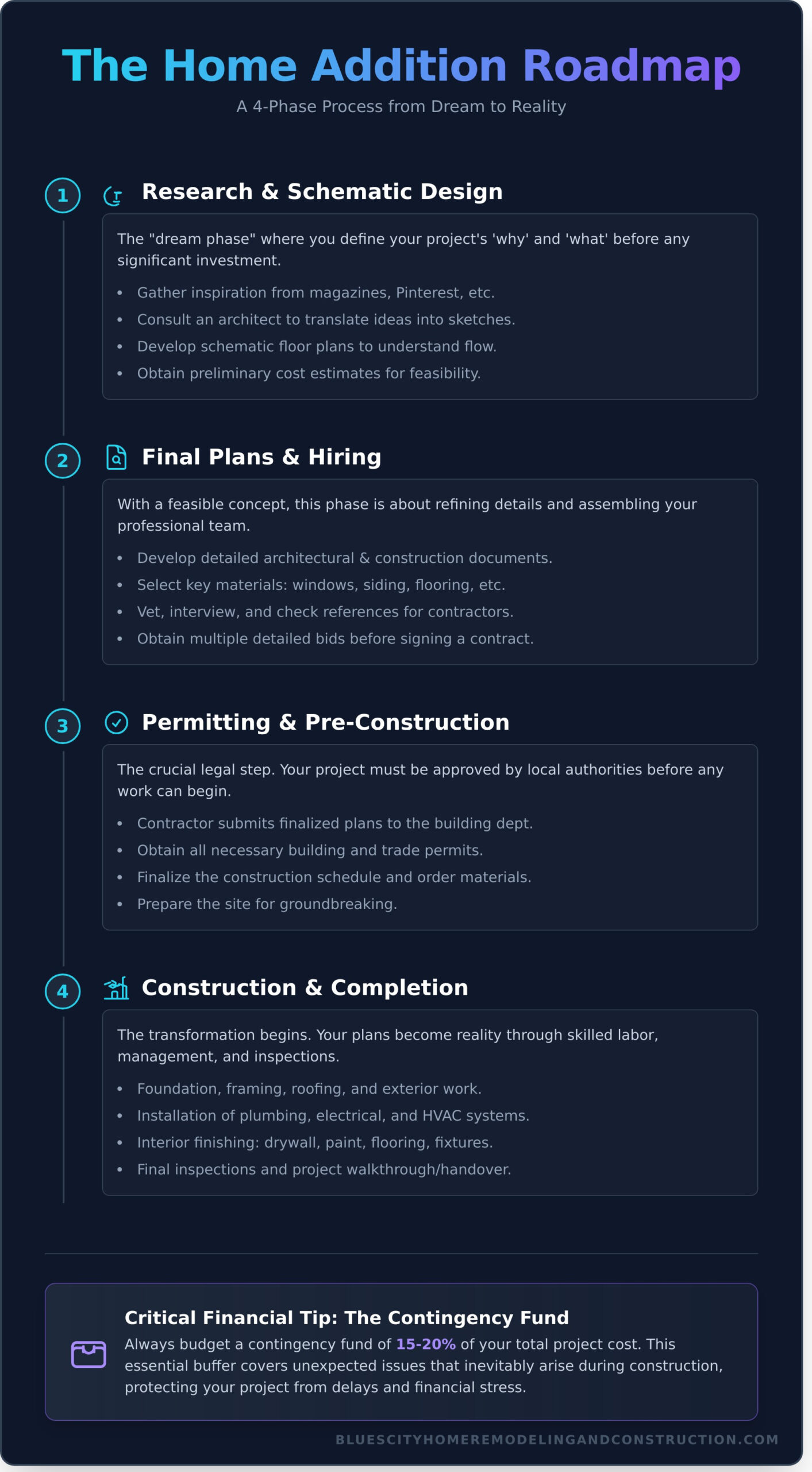
The Home Addition Roadmap: A 4-Phase Process from Dream to Reality
Embarking on a home addition can feel overwhelming, but a structured approach transforms a complex project into a series of manageable steps. Successful home additions are built on a foundation of careful planning, not speed. By breaking the journey into four distinct phases, you can navigate the process with confidence, ensuring your vision is realized on time and on budget. This roadmap demystifies what lies ahead, from initial sketches to the final walkthrough.
Phase 1: Research and Schematic Design
This is the dream phase, where you define your “why” and “what.” Start by gathering inspiration from sources like Pinterest, architectural magazines, and neighborhood tours to solidify your vision. Next, consult with an architect or designer. They will translate your ideas into initial sketches and schematic floor plans, helping you understand spatial flow and functionality. This conceptual design is crucial for getting preliminary cost estimates to ensure your project is financially feasible before you invest further.
Phase 2: Finalizing Plans and Hiring a Contractor
With a feasible concept in hand, it’s time to refine the details. Your designer will develop the sketches into detailed architectural plans and construction documents that specify every element. During this phase, you will make key material selections-from windows and siding to flooring and fixtures. Simultaneously, you’ll begin the critical process of vetting and interviewing general contractors. Always check references, review past projects, and obtain multiple detailed bids before signing a contract.
Phase 3: Permitting and Pre-Construction
Before any ground is broken, your project must be legally approved. Your contractor will submit the finalized construction documents to your local building department to obtain the necessary permits. This can sometimes take several weeks. While waiting for approval, your contractor will finalize the construction schedule, order long-lead materials like custom windows or trusses, and coordinate with subcontractors. This is also when your property will be prepared for construction, which may involve site clearing and setting up barriers.
Phase 4: Construction and Completion
This is where your vision physically takes shape. The construction process for most home additions follows a predictable sequence:
- Foundation: Excavation, footings, and pouring the concrete foundation.
- Framing & Exterior: Building the structure, sheathing, roofing, and installing windows.
- Mechanicals: Rough-in for plumbing, electrical, and HVAC systems.
- Finishes: Insulation, drywall, painting, flooring, and installing cabinetry and fixtures.
Consistent communication with your contractor through regular site meetings is vital. Once construction is complete, you’ll conduct a final walkthrough to create a “punch list” of any remaining items to address before the final payment and project closeout.
Assembling Your Dream Team: Who You Need for a Successful Project
A successful home addition isn’t a solo endeavor; it’s a collaborative effort that requires a team of skilled professionals. Understanding who does what is the first step toward a smooth process. From initial concept to final walkthrough, each expert plays a vital role in bringing your vision to life and ensuring the project meets code, budget, and quality standards.
Architect vs. Designer vs. Draftsperson
Choosing the right design professional depends on your project’s complexity. Their primary goal is to translate your ideas into a buildable set of plans.
- Architect: A state-licensed professional required for complex projects involving significant structural changes or unique engineering challenges. They provide stamped drawings necessary for permits.
- Building Designer: Focuses on space planning, aesthetics, and function. They are an excellent choice for less complex home additions where major structural engineering isn’t required.
- Draftsperson: A technical specialist who creates detailed construction drawings based on plans from an architect or designer.
The Role of the General Contractor
Think of the General Contractor (GC) as the conductor of your orchestra. Once the plans are finalized, the GC takes over, managing every aspect of the construction phase. They are your single point of contact and responsibility, handling everything from hiring and vetting subcontractors (plumbers, electricians, etc.) to managing schedules, ordering materials, and ensuring the work is done to the highest standard.
Hiring a licensed, insured, and experienced GC is non-negotiable. It protects you from liability and ensures your project is built safely and correctly.
Understanding Design-Build Firms
An increasingly popular approach is the design-build model, which streamlines the entire process. Instead of hiring separate design and construction companies, you work with a single firm under one contract. This integrated team handles everything from initial concept and architectural drawings to construction and final touches.
The benefits are significant: improved communication, greater accountability, and often faster project timelines with better budget control. Because the design and construction teams work together from day one, potential issues are identified and solved early. At Blues City, we offer a seamless design-build experience, ensuring your project is cohesive and efficient from start to finish.
Financing Your Addition and Understanding Return on Investment (ROI)
Once you have a clear vision and preliminary plans, the biggest question emerges: “How will I pay for this?” Understanding your financing options and the potential return on investment (ROI) is crucial for making a sound financial decision. While the total cost can be significant, several common methods can make your project achievable. For a complete breakdown of expenses, see our detailed guide on Home Addition Costs.
Common Financing Options
Most homeowners use their home’s equity to fund large-scale projects. The three most popular methods include:
- Home Equity Loan: This is a lump-sum loan with a fixed interest rate and predictable monthly payments, making it ideal for a project with a set budget.
- Home Equity Line of Credit (HELOC): A HELOC functions like a credit card, offering a revolving line of credit you can draw from as needed. This provides flexibility for unexpected costs but often comes with a variable interest rate.
- Cash-Out Refinance: This option involves replacing your current mortgage with a new, larger one, allowing you to take the difference in cash. It’s a good choice if you can also secure a lower interest rate on your primary mortgage.
How to Think About ROI
When it comes to home additions, the return isn’t just financial. While some projects recoup a significant portion of their cost upon resale, very few offer a 100% return. ROI varies widely based on your local real estate market and the type of addition. Generally, projects that add functional square footage, like a new bathroom or a primary suite, tend to have a higher financial ROI.
However, don’t discount the lifestyle ROI. This is the immeasurable value you get from enjoying your new space every day-the extra room for your growing family, the home office that boosts your productivity, or the sunroom where you relax. This personal enjoyment is often the most important return of all.
Ready to explore the financial and personal potential of your home? Contact Blues City Home Remodeling & Construction to discuss your project today.
Your Home Addition Journey Starts Now
Embarking on a home addition is a significant but incredibly rewarding endeavor. As we’ve explored, the path to success is paved with careful planning, from assembling the right professional team to understanding the financial investment. A well-executed project doesn’t just add square footage; it enhances your lifestyle and adds lasting value to your property for years to come.
For homeowners in the Bartlett and Memphis community, navigating the complexities of home additions is easier with a trusted partner. At Blues City Home Remodeling and Construction, we bring years of experience and a deep commitment to quality craftsmanship to every project. We pride ourselves on integrity and clear communication, ensuring your vision becomes a reality, on time and on budget.
We are experienced in all types of additions, from simple bump-outs to complex second-story expansions. Ready to plan your dream space? Get a detailed home addition quote today. Let’s build the home you’ve always envisioned, together.
Frequently Asked Questions About Home Additions
How long does a typical home addition take to complete?
A typical home addition project can take anywhere from 4 to 12 months from the initial design to final completion. The pre-construction phase, including design, engineering, and securing permits, often takes 1 to 4 months. The construction itself can last 3 to 8 months or more, depending on the project’s size, complexity, weather delays, and the availability of materials and subcontractors. A simple single-room bump-out will be much faster than a two-story addition.
Do I need a building permit for my home addition?
Yes, in almost all cases you will need a building permit for a home addition. Permits ensure that the new construction complies with local zoning laws, building codes, and safety standards. This process involves submitting detailed architectural plans to your local building department for approval. Your contractor typically manages the permit application process, but it is the homeowner’s legal responsibility to ensure all work is properly permitted before construction begins.
Can I live in my house during the construction of an addition?
It is often possible to live in your home during construction, but you should prepare for significant disruptions. Expect noise, dust, and periodic utility shutoffs for plumbing or electrical work. It’s crucial to establish clear boundaries and a communication plan with your contractor to manage daily life. For large-scale projects that affect key areas like the kitchen or all bathrooms, temporarily relocating might be a more comfortable and practical option for your family.
How do I find and choose a reliable home addition contractor?
Start by asking for referrals from friends, family, or local architects. Vet potential contractors by checking their license, insurance, and online reviews. Request to see a portfolio of their completed projects and ask for at least three recent references you can call. Finally, obtain detailed, written bids from your top choices. A reliable contractor will provide a clear contract outlining the scope of work, timeline, payment schedule, and materials to be used.
What are the biggest hidden costs in a home addition project?
The biggest hidden costs often come from unforeseen issues discovered after demolition. These can include repairing rotted wood, fixing foundation problems, or upgrading outdated electrical or plumbing systems to meet current codes. Other potential costs for your home addition include landscaping repairs after construction and the need to upgrade your HVAC system to properly heat and cool the new space. It is wise to set aside a contingency fund of 10-20% of your total budget.
Will a home addition increase my property taxes?
Yes, a home addition will almost certainly increase your property taxes. By adding square footage and value to your house, you increase its assessed value. Once the project is complete and the final permits are closed, your local tax assessor’s office will be notified. They will then re-evaluate your property’s value, which will result in a higher property tax bill. This is an important long-term cost to consider when planning for home additions.