Dreaming of a stunning new kitchen but feeling a knot in your stomach when you think about the budget? You’re not alone. The fear of spiraling expenses and hidden fees can turn an exciting project into a stressful one. The biggest source of this anxiety often comes down to one major unknown: the true kitchen remodel cost. It can feel like a mysterious number, making it impossible to know if your vision for new cabinets, sparkling countertops, and modern appliances is a realistic goal or just a far-off dream.
This guide is here to replace that uncertainty with clarity and confidence. We are breaking down everything you need to know about 2026 kitchen renovation expenses, from a minor refresh to a full-gut demolition and rebuild. You’ll get a detailed look at where every dollar goes, learn actionable tips to save money without sacrificing style, and gain the knowledge you need to create a smart, effective budget. Let’s get you ready to plan the kitchen you’ve always wanted, without the financial surprises.
Key Takeaways
- Learn the 2026 average costs for minor, mid-range, and major renovations to establish a realistic baseline for your project.
- Understand the key project decisions that have the biggest impact on your final kitchen remodel cost and learn how to manage them.
- Discover where your money actually goes with a percentage-based breakdown of a typical kitchen renovation budget, from cabinets to labor.
- Get actionable strategies for creating a smart budget and saving money on your renovation without compromising on your vision.
Understanding Average Kitchen Remodel Costs in 2026
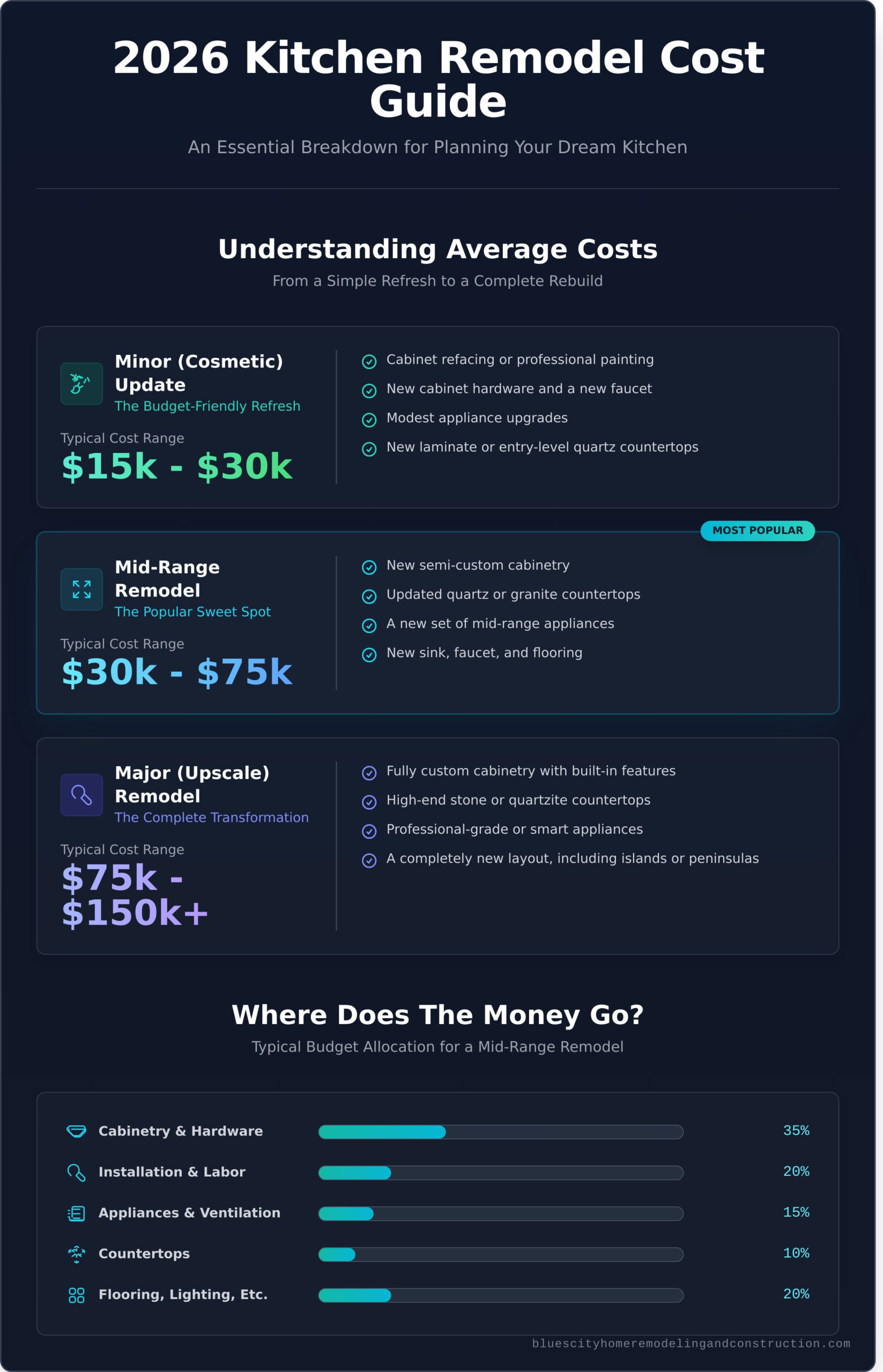
Planning your budget starts with understanding the typical kitchen remodel cost. While every project is unique, national averages provide a solid baseline for what you can expect to invest. The modern kitchen is far more than just a place to cook; it’s the central hub of family life. Understanding the history and evolution of kitchens helps explain why these spaces are so vital and why remodeling them is such a popular investment. Data from sources like Remodeling Magazine’s annual Cost vs. Value report shows that costs are typically broken into three tiers based on project scope-the single biggest factor determining your final price. Keep in mind that these national figures will be adjusted by local factors here in the Memphis, TN area, including labor rates and material availability.
Minor (Cosmetic) Kitchen Update: The Budget-Friendly Refresh
Typical Cost Range: $15,000 – $30,000
This tier is perfect for a kitchen that is structurally sound but needs a modern facelift. By keeping the existing layout and plumbing, you control costs while achieving a significant visual impact. It’s an ideal choice for homeowners looking to quickly boost their home’s appeal and functionality without a complete overhaul.
- Cabinet refacing or professional painting
- New cabinet hardware and a new faucet
- Modest appliance upgrades
- New countertops (e.g., laminate or entry-level quartz)
Mid-Range Remodel: The Most Popular Choice
Typical Cost Range: $30,000 – $75,000
Representing the sweet spot for many homeowners, a mid-range remodel offers a comprehensive update and often yields the highest return on investment. This project replaces most major components of the kitchen but avoids the complexity and expense of moving walls or reconfiguring plumbing and electrical systems.
- New semi-custom cabinetry
- Updated countertops (e.g., quartz or granite)
- A new set of mid-range appliances
- New sink, faucet, and flooring
Major (Upscale) Remodel: The Complete Transformation
Typical Cost Range: $75,000 – $150,000+
For those dreaming of a complete transformation, a major or upscale remodel redefines the entire space. This tier often involves changing the kitchen’s layout to improve workflow, which may require moving walls, plumbing, and electrical lines. It’s designed for homeowners who want a truly custom, premium kitchen with high-end features and finishes.
- Fully custom cabinetry with built-in features
- High-end stone or quartzite countertops
- Professional-grade or smart appliances
- A completely new layout, including islands or peninsulas
Where Does the Money Go? A Detailed Kitchen Remodel Cost Breakdown
Understanding where your budget is allocated is the first step toward smart financial planning for your renovation. While every project is different, the overall kitchen remodel cost typically breaks down into predictable categories. Data on average kitchen remodel costs reveals a consistent pattern, helping you anticipate where the biggest expenses will lie. Knowing these percentages allows you to prioritize spending on what matters most to you and identify potential areas for savings.
While every project is unique, a typical mid-range kitchen remodel budget often allocates the largest portions to cabinetry and hardware (around 35%). Installation and labor costs typically account for approximately 20%, while appliances and ventilation usually make up about 15%. Countertops generally represent around 10% of the budget, with the remaining 20% covering other essential elements such as flooring, lighting, plumbing fixtures, and miscellaneous finishes.
Cabinetry & Hardware (30-35% of Budget)
As the most prominent feature in your kitchen, cabinetry is almost always the single largest expense. The final cost depends heavily on your choice between stock, semi-custom, or fully custom cabinets. Stock options offer the best value, while custom cabinets provide endless personalization at a premium price. Don’t forget hardware-knobs and pulls are small details that make a significant design impact.
Installation & Labor (15-20% of Budget)
Never underestimate the value of professional craftsmanship. This portion of your budget covers the skilled labor required for demolition, plumbing, electrical work, and the precise installation of all your new materials. Hiring qualified professionals ensures your kitchen is not only beautiful but also safe, functional, and built to local building codes. This is an investment in quality and peace of mind.
Appliances & Ventilation (10-15% of Budget)
The price of appliances can range dramatically, from standard, reliable models to high-end, smart-enabled units. Your budget should account for a complete suite, including a refrigerator, range or cooktop, oven, dishwasher, and microwave. A critical but often overlooked component is proper ventilation. An effective range hood is essential for maintaining air quality and protecting your new cabinets from grease and moisture.
Countertops (10-15% of Budget)
Your choice of countertop material is a major driver of both your project’s final look and its total kitchen remodel cost. Each material offers a different balance of aesthetics, durability, and price. Consider the spectrum of popular options:
- Laminate: Most budget-friendly.
- Granite: A durable mid-range natural stone.
- Quartz: A popular, low-maintenance engineered stone in the mid-to-high range.
- Marble: A high-end choice known for its luxurious look but requires more care.
7 Key Factors That Drive Your Final Remodel Cost
While new appliances and countertops get most of the attention, the biggest drivers of your final kitchen remodel cost are often the choices you make about the project’s scope and complexity. Understanding these key factors gives you direct control over your budget. Some are conscious choices you can adjust, while others are non-negotiable necessities. Discussing them with your contractor early in the process is the best way to prevent costly surprises down the road.
1. Kitchen Size & Square Footage
It’s a simple rule: a larger kitchen requires more of everything. More square footage directly translates to higher expenses for materials like flooring, countertops, and backsplash tile, as well as the number of cabinets you’ll need. Labor costs also increase with the size of the space. Many estimates are calculated on a per-square-foot or linear-foot basis, so the dimensions of your room are the foundational element of your budget. Costs for materials and labor can also vary significantly based on your location; understanding regional cost differences is a key part of accurate financial planning.
2. Changing the Kitchen Layout
Keeping your kitchen’s existing footprint is one of the most effective ways to manage your budget. As soon as you decide to alter the layout, you introduce significant expenses that go far beyond aesthetics. These structural and mechanical changes require licensed professionals and can quickly inflate your total cost.
- Moving Walls: Removing, adding, or relocating walls involves structural work, reframing, and extensive drywall repair. If the wall is load-bearing, the cost and complexity increase dramatically.
- Relocating Plumbing: Moving a sink or dishwasher even a few feet requires a licensed plumber to reroute supply and drain lines within your walls or floor.
- Rerouting Utilities: Shifting the location of your range or wall ovens may require moving gas lines or installing new 220v electrical circuits, both of which are jobs for certified experts.
3. Quality of Materials & Finishes
Nearly every component in your kitchen comes in a range of price points, often following a ‘good, better, best’ model. Your selections here have a massive impact on the budget. For example, laminate countertops are highly affordable, while high-end quartzite or marble can cost ten times as much. This principle applies to flooring (vinyl vs. hardwood), lighting fixtures (big-box store vs. designer), and even paint. Balancing your dream finishes with practical, budget-friendly alternatives is essential for a successful remodel.
4. Structural & Mechanical Surprises
What you can’t see behind the walls can have a major impact on your budget, especially in older homes. During demolition, your contractor might uncover outdated electrical wiring that isn’t up to code, corroded plumbing pipes, or hidden water damage. These issues are not optional fixes; they must be addressed to meet current building and safety standards. This is precisely why a contingency fund of 15-20% of your total budget is not just recommended-it’s an absolute necessity.
How to Create a Smart Budget and Save Money
A successful kitchen remodel hinges on a well-planned budget. This isn’t about cutting corners; it’s about making strategic financial decisions that prevent stress and deliver the best value. A smart budget is your roadmap, ensuring every dollar is spent wisely and protecting you from costly surprises down the road.
Establish a Realistic Budget (and a Contingency Fund)
Before you fall in love with a specific design, determine what you can comfortably afford. Start with your total number, then research costs for your desired level of finish-basic, mid-range, or luxury-to see how your vision aligns with reality. Most importantly, set aside a contingency fund of 10-20% of your total budget. This buffer covers unforeseen issues like hidden water damage or electrical problems that can inflate your final kitchen remodel cost.
Decide Where to Save and Where to Splurge
Not all components of your kitchen are created equal. To maximize your investment, allocate more of your budget to high-impact, high-use items that are difficult to change later. Consider this simple framework:
- Splurge: Invest in quality custom or semi-custom cabinets and durable, long-lasting countertops. These are the workhorses of your kitchen and define its look and feel.
- Save: You can save on elements that are easier to upgrade later, such as cabinet hardware, lighting fixtures, and even the backsplash.
- Major Savings: Keeping your kitchen’s existing layout is the single most effective way to control costs, as it avoids expensive plumbing, electrical, and structural changes.
Understanding the Return on Investment (ROI)
Think of your project as an investment in your home’s equity. While the initial kitchen remodel cost can be significant, a well-executed project adds tangible value. Industry data consistently shows that mid-range remodels often recoup a higher percentage of their cost upon resale compared to high-end, luxury renovations. To secure the best long-term ROI, focus on timeless design choices-like a classic subway tile backsplash or neutral cabinet colors-that will appeal to a wide range of future buyers.
Need help aligning your vision with a practical budget? A professional consultation can provide clarity. Contact Blues City Home Remodeling and Construction for a detailed estimate.
Why Online Calculators Fall Short: Getting an Accurate Local Quote
You’ve likely used an online estimator to get a ballpark figure for your project. While these tools are excellent for initial research, they provide a national average-not a real-world quote for your specific home. They are the starting point, not the finish line, for understanding your true kitchen remodel cost. To budget with confidence, you need to move from a generic estimate to a detailed, local proposal.
The Problem with Generic Cost Estimates
Online calculators are built on algorithms and averages, but your home is unique. A generic tool simply cannot account for the critical variables that drive the final price. For example, it doesn’t know the current labor and material rates in Bartlett, TN, which can differ significantly from national figures. More importantly, it can’t peek behind your walls to spot potential issues like old plumbing, faulty wiring, or hidden water damage that must be addressed for a safe and successful renovation.
Finally, your personal style is a major cost factor. A calculator won’t capture the significant price difference between stock cabinetry and custom-built options, or between laminate countertops and premium quartzite. These choices are personal, and they have a direct impact on the budget.
What a Professional Quote from Blues City Includes
An on-site consultation is the only way to get a firm, reliable price for your project. When you work with Blues City Home Remodeling and Construction, our proposal is more than just a number; it’s a comprehensive plan tailored to your home and vision. We believe in complete transparency, so you know exactly what to expect.
Our professional quotes always include:
- A detailed, itemized list: We break down all material and labor costs, from demolition and permits to fixtures and finishes. You’ll see precisely where your investment is going.
- A clear scope of work: We define every task and deliverable to ensure there are no surprises or misunderstandings. You’ll know exactly what is included in the project.
- A proposed timeline and payment schedule: We outline key project milestones and a clear payment structure, so you can plan your finances accordingly.
Stop guessing what your new kitchen might cost. Get a clear, accurate, and actionable plan from a trusted local expert. Schedule your free, no-obligation consultation today!
Transform Your Kitchen with Confidence and Clarity
As we’ve explored, understanding your total kitchen remodel cost is about more than just a national average. It’s about recognizing how your specific choices in materials, layout, and labor shape the final price. Creating a detailed budget and knowing where your money is going are the first steps toward a successful project without surprises, and a local, professional quote is the only way to get true accuracy.
For homeowners in the Bartlett and Memphis, TN community, our team is committed to quality craftsmanship. We provide transparent, itemized bids so you can move forward with a clear financial picture and complete peace of mind. We believe you deserve to know exactly what you’re investing in before any work begins.
Don’t let budget uncertainty hold you back from creating the heart of your home. Ready to plan your dream kitchen? Get a free, detailed estimate from our team! Let’s work together to build a beautiful, functional space that fits your vision and your budget.
Frequently Asked Questions
How much should I budget for kitchen appliances?
As a general rule, plan to allocate 10% to 15% of your total kitchen remodel budget for new appliances. For a $60,000 project, this means setting aside $6,000 to $9,000. This range typically covers standard, good-quality brands. If you are considering professional-grade or luxury appliances from brands like Sub-Zero or Wolf, you should plan to budget 20% or more of your total project cost to accommodate the higher price points.
Can I save money by doing the demolition myself?
Yes, performing the demolition yourself, often called “DIY demo,” can save you between $500 and $1,500 in labor costs. However, it comes with risks. Without proper knowledge, you could accidentally damage plumbing, electrical wiring, or structural elements, leading to far more expensive repairs. If you are not experienced, it is often safer and more cost-effective in the long run to leave demolition to the professionals who are insured for such work.
How much do new kitchen cabinets typically cost?
Kitchen cabinets are one of the largest expenses, often accounting for 30% to 40% of the entire budget. Costs vary widely based on type. Stock cabinets are the most affordable, ranging from $100 to $300 per linear foot. Semi-custom cabinets offer more options and typically cost $200 to $700 per linear foot. Fully custom cabinets provide endless possibilities but are the most expensive, starting at $500 and easily exceeding $1,500 per linear foot.
Does a kitchen remodel add value to my home?
Absolutely. A well-executed kitchen remodel is one of the best investments you can make in your home, often providing a return on investment (ROI) of 50% to 80%. While you may not recoup the entire expense upon selling, a modern, functional kitchen significantly increases your home’s marketability and can help it sell faster. It also dramatically enhances your daily enjoyment of the space, which provides its own invaluable return.
What are the most common hidden costs in a kitchen remodel?
Unexpected issues often increase the final kitchen remodel cost. Common hidden expenses include discovering outdated electrical wiring that is not up to code, finding hidden water damage or mold behind walls, needing to reroute plumbing, and paying for unforeseen permit fees. To prepare for these surprises, it is crucial to include a contingency fund of at least 10% to 20% of your total budget. This buffer will help you handle unexpected costs without derailing your project.
How long does it take to get a detailed quote for a kitchen remodel?
Receiving a truly detailed and accurate quote from a reputable contractor typically takes one to three weeks. This process involves more than just a quick estimate. It requires an in-home consultation, precise measurements, initial design discussions, material selections, and coordination with subcontractors like plumbers and electricians. A quote that is provided too quickly may be inaccurate and overlook crucial details that affect your final project cost and timeline.