That initial thrill of planning a home renovation-imagining the finished space, the improved lifestyle-can quickly be overshadowed by a wave of anxiety. You’ve heard the horror stories: the contractor who vanishes with your deposit, the project that spirals wildly over budget, the shoddy workmanship that reveals itself months later. The fear of your dream turning into a costly nightmare is completely valid, especially when you don’t know the early signs of a bad contractor. It’s your home and your hard-earned money on the line, and the stress of making the wrong choice can be overwhelming.
But it doesn’t have to be a gamble. This guide is your essential toolkit for navigating the hiring process with confidence. We’re pulling back the curtain on 15 critical red flags to watch for, from the first phone call to the final walkthrough. By the end of this article, you’ll be equipped to spot trouble before it starts, ask the right questions, and select a reliable professional who will respect your investment and deliver the high-quality results you deserve. Let’s turn that anxiety into action and ensure your project is a success from start to finish.
Key Takeaways
- Evaluate a contractor’s communication and professionalism from your very first interaction to spot early warning signs.
- Protect yourself with a detailed, written contract; vague agreements or requests for large upfront cash payments are major red flags.
- Learn the on-the-job signs of a bad contractor to address issues like poor workmanship or missed deadlines before they escalate.
- Understand the key differences between a questionable bid and a professional proposal to confidently hire the right pro for your project.
Phase 1: Red Flags During the Vetting and Bidding Process
The initial vetting and bidding process is your first and best line of defense against hiring the wrong person for your project. How a contractor communicates and presents themselves from day one is often a direct reflection of the quality of work and service you can expect. Paying close attention to these early interactions can help you spot the most obvious signs of a bad contractor and filter out unqualified candidates before you waste any time. Above all, trust your gut-if something feels off, it probably is.
Poor Communication and Lack of Professionalism
Professionalism starts with the first phone call. If a contractor is difficult to get ahold of, consistently misses scheduled appointments, or leaves your emails and voicemails unanswered for days, consider it a major warning. This behavior is unlikely to improve once they have your deposit. Also, take note of their presentation: arriving late without notice, showing up in a messy, disorganized vehicle, or appearing generally unprofessional are all red flags that point to a lack of respect for you and your project.
High-Pressure Sales Tactics and Vague Answers
A reputable contractor will provide a detailed bid and give you the space to make an informed decision. Be wary of anyone who pressures you to sign a contract on the spot or offers a “special price” that’s only good for today. These are common tactics used to prevent you from getting other quotes. Furthermore, if they can’t give you clear answers about their methods or who will be working in your home, it’s a problem. A key part of what a general contractor does is managing the project transparently. Vague responses about timelines or processes are significant signs of a bad contractor.
No Proof of License, Insurance, or Portfolio
Legitimacy is non-negotiable. A professional contractor will have no issue providing you with proof of their credentials. Be on high alert if a candidate:
- Hesitates, becomes defensive, or refuses to provide their state license number.
- Cannot show you a current certificate of both general liability and workers’ compensation insurance.
- Lacks a professional website or a portfolio of completed projects you can review.
- Provides references who are unavailable, vague, or give unenthusiastic reviews.
Any one of these issues is a serious red flag and is often enough to disqualify a contractor from consideration.
Phase 2: Warning Signs in the Contract and Payment Structure
Once you move past initial impressions, the proposal and contract phase is where a contractor’s true colors are revealed. Your contract is the single most important document protecting your investment, your home, and your peace of mind. Financial red flags and contractual loopholes are some of the most critical signs of a bad contractor, often pointing to inexperience, financial instability, or even outright intent to defraud you.
The ‘Too Good to Be True’ Bid
While an affordable price is appealing, a bid that is drastically lower than all others is a major warning. This rock-bottom price is often a bait-and-switch tactic. The contractor may be planning to cut corners by using substandard materials and unskilled labor, or they intend to make up the difference later through a series of expensive and unexpected “change orders.” A professional, transparent bid will be detailed, breaking down the costs for labor, materials, and permits-not just a single, suspiciously low number.
Vague, Incomplete, or No Written Contract
A contractor who prefers a “handshake deal” or provides a simple, one-page document is not protecting your interests. A legitimate contract is comprehensive and exists to protect both you and the contractor by clearly defining expectations. If the document you’re asked to sign is missing key details, stop. A proper contract must always include:
- A detailed scope of work, specifying exactly what will be done.
- A complete list of materials, including brand names and model numbers.
- A clear payment schedule tied to project milestones.
- Firm start and estimated completion dates.
- Procedures for how changes to the project (change orders) will be handled.
Demands for Large Upfront Payments or Cash Deals
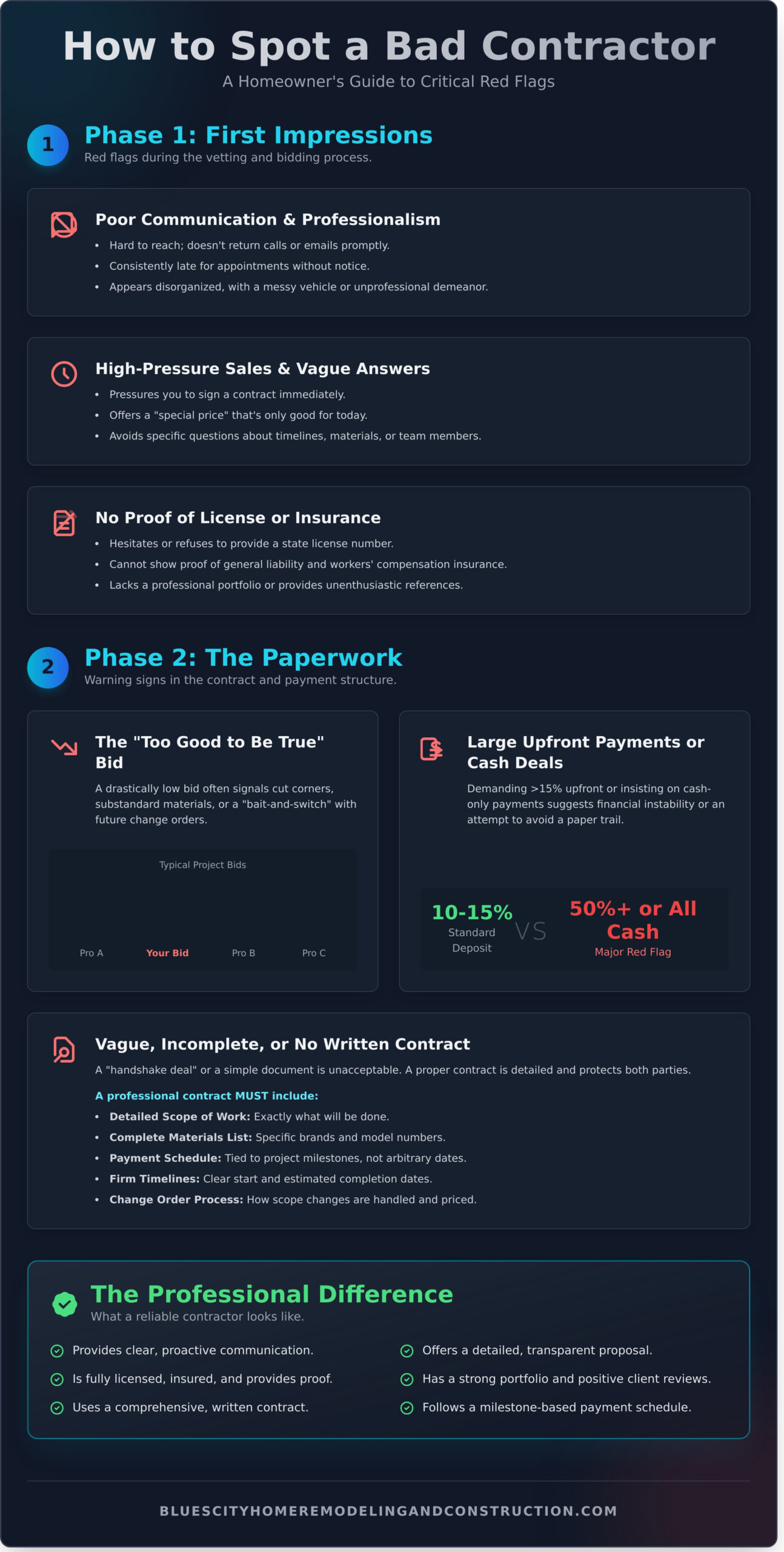
One of the clearest financial signs of a bad contractor is a demand for a massive upfront payment. While a small deposit is standard (typically 10-15% to cover initial materials), a request for 30%, 50%, or more before work begins suggests the contractor is underfunded and may use your money to pay off debts from a previous job. Insisting on cash-only payments is another red flag, as it may indicate they are avoiding taxes or trying to operate without a traceable record. Reputable contractors use a milestone-based payment schedule, where you pay installments as specific parts of the job are completed to your satisfaction.
Phase 3: On-the-Job Red Flags After the Project Starts
You’ve signed the contract, the deposit has cleared, and work has finally begun. Unfortunately, even a contractor who made a great first impression can show their true colors once the project is underway. The execution phase is where their organization, communication, and respect for your home are truly tested. Paying close attention to how they operate on-site is crucial for catching problems before they become costly disasters.
Skipping Permits or Ignoring Building Codes
If your contractor says, “Don’t worry, you don’t need a permit for this,” you should be very worried. Attempting to bypass the permitting process for any significant electrical, plumbing, or structural work is a massive red flag. This shortcut can lead to severe consequences:
- Fines and Stop-Work Orders: If the city discovers the unpermitted work, they can levy heavy fines and halt your project immediately.
- Forced Tear-Outs: You may be required to tear out finished work so an inspector can see what’s behind the walls, doubling your costs.
- Safety and Insurance Issues: Work that isn’t inspected and up to code can be unsafe and may not be covered by your homeowner’s insurance.
A professional contractor understands that securing the right permits is a non-negotiable part of the job that protects both you and them.
Inconsistent Schedule and Disappearing Crew
One of the most common signs of a bad contractor is the disappearing act. The crew works diligently for two days, then vanishes for a week with no explanation. This erratic schedule often means your contractor is juggling too many jobs and your project isn’t a priority. Worse, they may be using your deposit to buy materials for another client’s project. This behavior stalls all progress, extends your timeline indefinitely, and leaves your home in a chaotic, semi-finished state.
Messy Job Site and Lack of Respect for Your Home
While some mess is expected during a renovation, a complete disregard for your property is unacceptable. A disorganized job site with tools, debris, and materials scattered everywhere is not just unprofessional-it’s a serious safety hazard. A quality contractor will take steps to protect your home by covering floors and furniture, sealing off non-construction areas, and cleaning up the workspace at the end of each day. A consistently filthy site shows a lack of respect and is often indicative of the quality of their work. A team that respects your home is essential for a successful project, a standard we uphold at Blues City Home Remodeling and Construction.
How to Find a Good Contractor: The Professional Difference
Recognizing the signs of a bad contractor is the critical first step in protecting your investment. The next is knowing what to look for in a great one. A true professional doesn’t just avoid red flags; they actively demonstrate their value through clear communication, meticulous planning, and a commitment to quality craftsmanship. Investing a little extra time upfront to find the right partner can be the difference between a stressful, costly ordeal and a successful, rewarding project.
They Provide Clear, Comprehensive Contracts
A professional’s commitment to transparency begins with their contract. Vague agreements are a hallmark of unreliable operators. A reputable contractor will provide a detailed document that leaves no room for confusion. It should clearly outline:
- The full scope of work, including specific tasks and deliverables.
- A list of materials to be used, including brands and quality levels.
- A realistic project timeline with key milestones and a completion date.
- A clear payment schedule tied to project progress.
- Warranty information for both labor and materials.
Everything is put in writing for your protection, ensuring both parties are aligned from day one. Learn about our transparent process and commitment to quality.
They are Licensed, Insured, and Established
Legitimacy isn’t a secret. A great contractor operates as a professional business and has the credentials to prove it. They will proudly display their state license number and willingly provide certificates of both general liability insurance and workers’ compensation coverage. Look for an established presence, including a physical business address, a portfolio of completed projects, and glowing client testimonials. These elements demonstrate stability and a long-term commitment to their trade and community.
They Communicate Proactively
Poor communication is one of the most frustrating signs of a bad contractor. In contrast, a professional builds a relationship on a foundation of proactive communication. From the initial consultation, they set clear expectations for how and when they will provide updates. You should feel comfortable reaching out and confident that they will respond promptly. When challenges inevitably arise, they address them head-on with solutions, not excuses. This open dialogue builds trust and keeps the project on track.
Build with Confidence: Choose a Professional Partner for Your Home
Your home renovation is a significant investment, and the right partner makes all the difference. From vague bids and high-pressure sales tactics to unclear contracts and poor on-site communication, learning to spot the signs of a bad contractor is your best defense. By staying vigilant and demanding transparency at every step, you can safeguard your project, your budget, and your peace of mind, ensuring the final result is exactly what you envisioned.
Don’t leave your dream project to chance. At Blues City Home Remodeling & Construction, we build trust before we ever build a wall. As a fully licensed and insured team in Tennessee, we provide detailed, transparent bids and contracts, backed by an unwavering commitment to professionalism and customer satisfaction. Work with a contractor you can trust. Contact Blues City for a professional consultation. Let’s build something great together.
Frequently Asked Questions
What should I do if I’ve already hired a contractor and am seeing these red flags?
If you’re seeing signs of a bad contractor, act quickly. Start by documenting everything: take photos of the work, save all emails, and keep a log of conversations. Then, communicate your specific concerns to the contractor in writing. Refer to your contract to understand the terms for resolving disputes or terminating the agreement. If the issues persist and the contractor is unresponsive, it may be time to consult a legal professional for advice on your next steps.
Is the lowest bid for a construction project always a bad sign?
While not always a bad sign, an unusually low bid warrants serious caution. It could indicate the contractor is cutting corners on materials, using unskilled labor, or misunderstands the project’s scope, leading to surprise costs later. A professional bid should be detailed and transparent. Always compare at least three bids line-by-line to ensure they cover the same quality of work and materials. A bid that’s significantly lower than others is a major red flag.
What are the most important things that must be included in a construction contract?
A strong construction contract must be detailed. It should include a full scope of work, a clear payment schedule tied to project milestones, and specific start and completion dates. It must also list the exact materials to be used, proof of the contractor’s liability insurance and workers’ compensation, and a clause for handling change orders. Finally, ensure it contains information on warranties and a lien waiver to protect your property from claims by subcontractors.
How can I verify a contractor’s license and insurance in Tennessee?
In Tennessee, you can verify a contractor’s license online using the Department of Commerce and Insurance’s license search portal. Simply enter the contractor’s name or license number. For insurance, ask the contractor for a Certificate of Insurance (COI). Do not just take their word for it; call the insurance company listed on the certificate to confirm that the general liability and workers’ compensation policies are active and provide adequate coverage for your project.
Why is paying a contractor in cash a bad idea for a homeowner?
Paying in cash is risky because it leaves no official paper trail. Without a canceled check, credit card statement, or bank transfer record, you have no firm proof of payment if a dispute arises. This can leave you vulnerable if the contractor claims you never paid or abandons the job. Always use a traceable payment method to protect your financial investment. A contractor who insists on cash-only payments is a significant warning sign.