Hiring a contractor can feel like a high-stakes gamble. You’re not just betting your hard-earned money; you’re betting on the future of your home. Visions of budget-busting delays, shoddy workmanship, and communication blackouts can turn an exciting home improvement project into a source of constant stress. But it doesn’t have to be a roll of the dice. Having the right set of questions to ask a contractor is your ultimate tool for turning anxiety into action and uncertainty into confidence.
That’s exactly why we created this comprehensive checklist. These 21 essential inquiries are designed to help you vet potential partners thoroughly, look beyond the initial quote, and gauge their true professionalism and reliability before you sign a contract. By the end of this guide, you’ll be empowered to sidestep the common pitfalls, eliminate the guesswork, and confidently choose the right partner to bring your vision to life-on time, on budget, and without the headaches.
Key Takeaways
- Go beyond a simple quote by first verifying a contractor’s license, insurance, and professional credentials to protect your home and finances.
- Establish clear expectations for the project’s timeline, daily logistics, and communication plan to ensure the renovation process runs smoothly.
- The right questions to ask a contractor about costs, payment schedules, and change orders are essential to preventing surprise expenses and budget overruns.
- Finalize your decision with confidence by learning how to properly check references and what key elements must be included in your written contract.
Part 1: Verifying Credentials and Experience
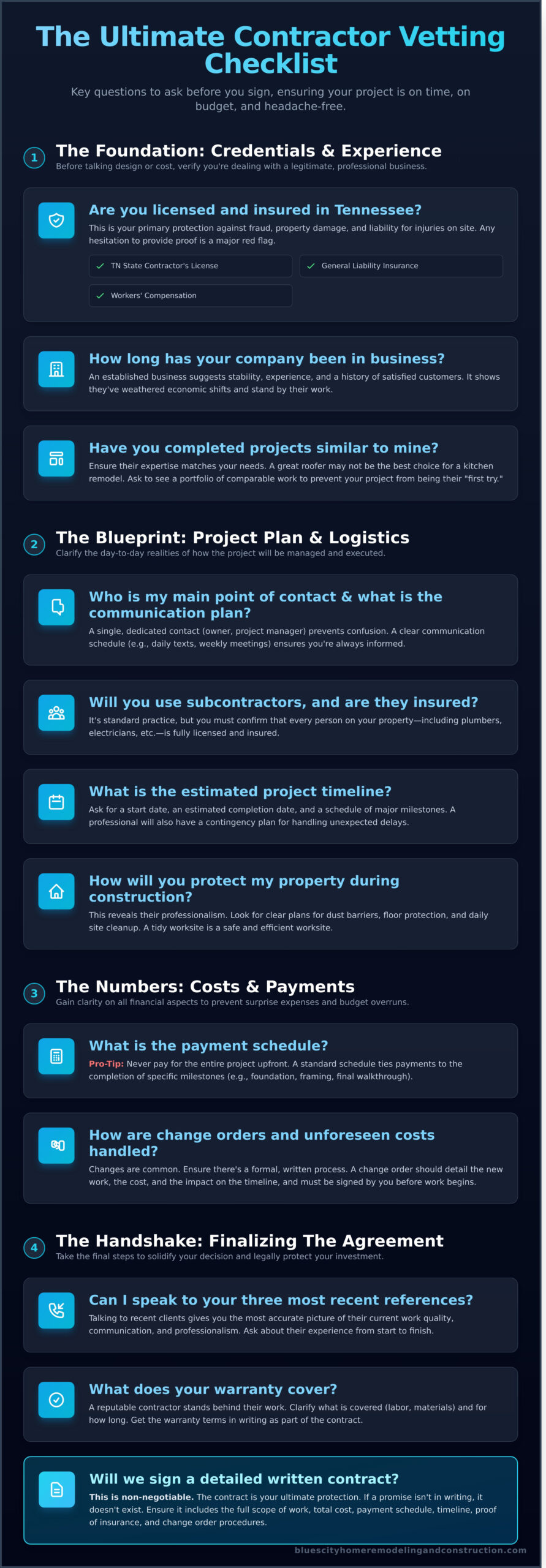
Before you discuss design, materials, or timelines, you must confirm you are dealing with a legitimate, professional business. The initial questions to ask a contractor should focus on verifying their credentials. These non-negotiable inquiries are your first line of defense against fraud, shoddy workmanship, and serious financial liability. A reputable contractor will have this information readily available and will be happy to provide it. Any hesitation or dismissiveness in response to these fundamental questions is a major red flag that you should walk away.
Are you licensed and insured in Tennessee?
This is the most critical question of all. A professional contractor must be able to provide their Tennessee state contractor’s license number. Equally important, ask for certificates proving they carry current insurance. Specifically, you need to see proof of:
- General Liability Insurance: This covers damage to your property caused by the contractor or their team.
- Workers’ Compensation Insurance: This protects you from liability if a worker is injured on your job site. Without it, you could be held financially responsible for medical bills and lost wages.
Beware of contractors who insist on cash-only deals or claim insurance isn’t necessary for your project. This is a sign they are cutting corners and putting you at risk.
How long has your company been in business?
While a new company isn’t automatically a bad choice, a long-established business suggests stability and a history of satisfied customers. Ask about the company’s track record in your local community. Dig a little deeper by also asking about the hands-on construction experience of the company’s principals or owners. A contractor with deep roots in the industry is more likely to stand by their work and have reliable relationships with suppliers and subcontractors.
Have you completed projects similar to mine?
General construction is a vast field, and not all experience is created equal. A contractor who specializes in roofing may not be the best choice for a complex kitchen remodel. It’s vital they have a portfolio of successfully completed projects that are similar in scope and style to yours. Understanding what a general contractor does-managing budgets, schedules, and tradespeople-is important, but their specific experience with your project type is what prevents costly errors and ensures a successful outcome. Don’t let your project be their first attempt.
Part 2: Understanding the Project Plan and Logistics
Once you’ve vetted a contractor’s credentials, the focus shifts from who they are to how they work. The following questions clarify the day-to-day realities of the project, including timelines, personnel, and communication. Clear, confident answers signal a well-organized process, while vague responses can be a major red flag for poor planning and potential frustration down the road.
Who will be the project manager or main point of contact?
Establishing a single, clear communication channel is crucial. Ask who your dedicated point of contact will be-whether it’s the owner, a site foreman, or a project manager. Knowing exactly who to call with a question or concern prevents confusion. Also, clarify the communication schedule. Will you receive daily texts, weekly email summaries, or scheduled on-site meetings? A good contractor will have a standard procedure for keeping you informed.
Will you be using subcontractors? Are they insured?
Most general contractors hire specialized subcontractors for tasks like electrical, plumbing, or HVAC. This is standard practice, but it’s important to know who will be in your home. This is one of the most critical questions to ask a contractor to ensure everyone on-site is covered. Confirm that they only work with licensed and insured professionals. You can also ask:
- How long have you worked with your primary subcontractors?
- Do you have a master list of their insurance certificates?
- Will I be introduced to the lead person for each trade?
What is the estimated timeline for this project?
A professional contractor should be able to provide more than just a rough guess. Request a projected start date and an estimated completion date. For larger projects, ask for a basic schedule outlining major milestones, such as demolition, framing, plumbing rough-in, and final finishes. Crucially, discuss how they manage unexpected delays caused by weather, supply chain issues, or unforeseen discoveries. Understanding their contingency plan provides valuable insight into their experience.
How will you protect my property during construction?
This question reveals a contractor’s respect for your home and their attention to detail. Inquire about their specific methods for protecting your property. This includes using plastic dust barriers to seal off work areas, laying down protective floor coverings in high-traffic zones, and their plan for daily site cleanup. A tidy worksite is a safe worksite, and a commitment to end-of-project cleaning ensures your home is returned to you in livable condition.
Part 3: Clarifying Costs and Payments
Money can be an uncomfortable topic, but discussing it upfront is critical to a successful project and a healthy working relationship. These financial-focused questions to ask a contractor are designed to protect you from surprise costs, hidden fees, and budget overruns. A trustworthy professional will welcome this transparency and provide clear, documented answers, while vague responses should be seen as a warning sign.
Can you provide a detailed, itemized estimate?
A single lump-sum price isn’t enough information. A professional estimate should provide a comprehensive breakdown of all projected costs. This allows you to see exactly where your money is going and make fair, apples-to-apples comparisons between different bids. Ask for an itemized list that includes:
- Labor costs
- Material quantities and prices
- Permit fees
- Subcontractor charges
- Any other project-specific fees
What is the payment schedule?
Never pay for the entire project upfront. A standard industry practice is to tie payments to the completion of specific project milestones. A typical structure involves a reasonable down payment (often limited to 10% or a fixed amount by state law), with subsequent payments due after key phases are finished, such as framing, electrical rough-in, or drywall. A contractor demanding a large percentage-like 50% or more-before work begins is a major red flag.
How are change orders handled?
Even with perfect planning, changes are common. You might want a different material, or the contractor might uncover an unexpected structural issue. Before signing a contract, ask about the formal process for “change orders.” A proper change order is a written document that you must approve and sign. It should clearly detail the new work, the associated cost (or credit), and any impact it will have on the project timeline.
What is included in the price versus what are allowances?
It is vital to understand the difference between a fixed cost and an “allowance.” An allowance is a placeholder budget for items you will select, like faucets, tile, or light fixtures. Ask for a list of all allowances in the contract and find out what happens if your choices are over or under the budgeted amount. A clear process for managing allowances is a mark of an experienced team like the one at Blues City Home Remodeling and Construction.
Part 4: Finalizing the Agreement and Checking References
You’ve vetted potential candidates and are close to making a choice. These final questions to ask a contractor are designed to move you from consideration to commitment, solidifying your decision and formalizing the relationship. A reputable contractor’s history of quality work and strong client relationships will speak for itself. This is your chance to verify that history and ensure your project is protected by a clear, comprehensive agreement.
Can you provide references from your last 3 projects?
Don’t just ask for a list of their “best” clients. Requesting contact information for their three most recently completed projects gives you an unbiased, current look at their performance. When you call, go beyond a simple “Were you happy?” Ask specific questions to get a clear picture:
- Was the project completed on time and within the agreed-upon budget?
- How did the contractor handle unexpected issues or changes?
- Was the team respectful of your home and property?
- Most importantly: Would you hire them again for another project?
The answers to these questions provide invaluable insight you won’t find anywhere else.
What does your warranty cover and for how long?
A professional contractor is proud of their craftsmanship and will stand behind it with a warranty. This isn’t just a verbal promise; it’s a written commitment to quality. Be sure to ask for specifics. Does the warranty cover labor, materials, or both? How long does the coverage last for different aspects of the project? A one-year warranty on labor is a common industry standard, but this can vary. Insist that all warranty details are explicitly written into your contract.
Will we be signing a detailed contract?
This is arguably one of the most critical questions to ask a contractor before any work begins. A verbal agreement or a simple one-page estimate is not enough to protect you. A professional contract is your ultimate safeguard, outlining every detail of the project. It should clearly define the scope of work, a detailed payment schedule, a start and end date, specific materials to be used, and procedures for handling change orders. Read every line carefully and make sure you understand it completely before signing.
A thorough contract is a sign of a trustworthy and organized professional. We build projects on trust and transparency. Talk to our team today.
Your Blueprint for Hiring the Right Contractor
Hiring a contractor is a major decision, but it doesn’t have to be a stressful one. By focusing on verifying credentials, clarifying the project scope, and understanding payment terms, you can eliminate surprises and protect your investment. Armed with this list of essential questions to ask a contractor, you are empowered to vet professionals thoroughly and find a true partner for your home renovation.
A reputable contractor will always welcome your due diligence with clear, transparent answers. At Blues City, we believe that trust is the foundation of every successful project. We are proud to be Fully Licensed & Insured in Tennessee, maintain an A+ Rating with the Better Business Bureau, and bring decades of combined experience to homeowners throughout the Memphis area.
Ready to work with a contractor who welcomes your questions? Schedule a consultation with Blues City. Let’s discuss your vision and build something amazing together. With the right team by your side, your dream home is closer than you think.
Frequently Asked Questions
What’s the difference between an estimate, a quote, and a bid?
An estimate is a rough, non-binding approximation of cost, like a ballpark figure. A quote or bid, however, is a formal, fixed-price offer for a specific scope of work. While an estimate helps with initial budgeting, a quote is what you’ll agree to in your contract. Always request a detailed, written quote that breaks down all labor and material costs before signing any agreement. This clarity prevents financial surprises down the road.
Is the lowest bid for a construction project always the best choice?
The lowest bid is rarely the best choice. An unusually low price can signal inferior materials, unskilled labor, or that the contractor is uninsured. It might also mean they’ve underestimated the project’s scope, leading to expensive change orders later. Instead of focusing solely on price, evaluate each contractor’s experience, references, and the detailed scope of work provided in their bid. The best value combines fair pricing with quality and reliability.
What are the biggest red flags to watch out for when hiring a contractor?
Beyond the essential questions to ask a contractor, watch for major red flags. These include demands for a large cash down payment, a lack of a physical business address, or an unwillingness to provide a written contract. High-pressure tactics to get you to sign immediately are also a bad sign. A reputable professional will be transparent, patient, and able to show proof of their license, bonding, and insurance without hesitation.
How much of a down payment is reasonable for a contractor?
A reasonable down payment is typically 10% of the total project cost, though some states have specific limits (e.g., $1,000 in California). This initial payment covers the cost of securing materials to begin the job. Be wary of any contractor who asks for 50% or more upfront. A large down payment removes their incentive to perform the work on schedule and could be a sign of financial instability or a potential scam.
Do I need to get my own permits for a home remodeling project?
Your contractor should be responsible for obtaining all necessary building permits. This is a standard part of their service, as they understand local building codes and inspection processes. If a contractor asks you to pull the permits yourself, consider it a serious red flag. This often means they are not licensed or insured, and they are attempting to shift legal responsibility for the project’s compliance and safety onto you, the homeowner.
What should I do if I have a dispute with my contractor mid-project?
If a dispute arises, first refer to your signed contract to clarify the agreed-upon terms. Then, document the issue in writing (an email is great for this) and request a meeting to discuss it calmly. Try to find a mutually agreeable solution. If you cannot resolve the problem directly, you may need to consider third-party mediation or consult with an attorney who specializes in construction law to understand your next steps.